Healthspan vs. Lifespan: What’s the Difference?
| 1 min read
00:00
00:00
About the Show
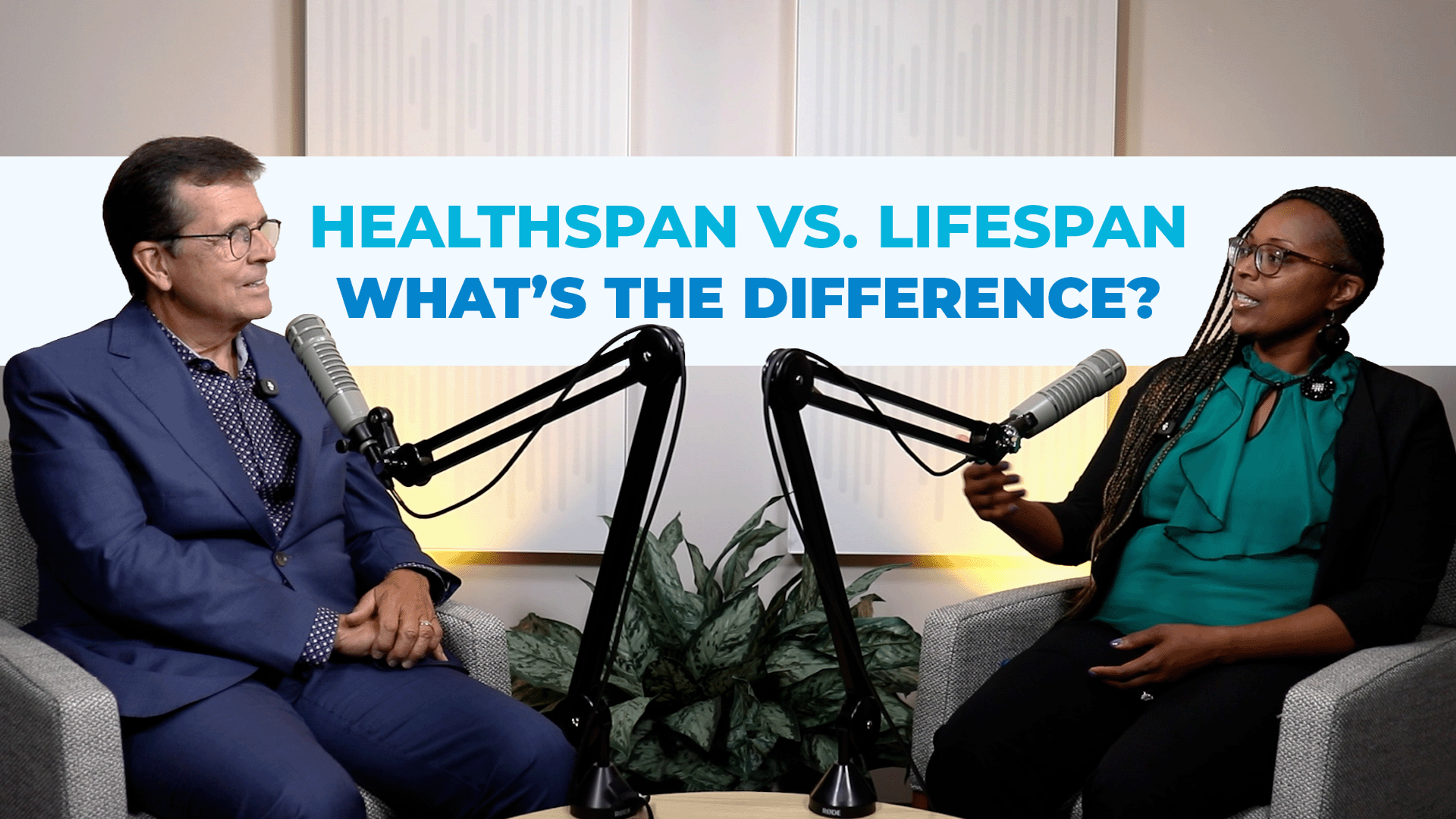
Everyone wants to live a long and happy life, but what about a healthy one? In recent years, you may have heard of healthspan in addition to lifespan. On this episode, Chuck Gaidica is joined by Blue Cross Medical Director Dr. Crystal Lee to explain the difference between your healthspan and lifespan and why they both matter.
In this episode of A Healthier Michigan Podcast, we explore:
- What is your lifespan?
- What is your healthspan?
- Can we improve both?
- How they affect each other
Transcript
Healthspan vs. Lifespan: What's the Difference and How Can You Improve Both?
Chuck Gaidica:
Most people want to live a long life. I know I do, but what if the bigger question isn’t just how long we live, it’s how well we live during those years. That’s the idea behind what healthspan is. While lifespan measures the number of years we live, healthspan focuses on the quality of those years, how long we’re able to stay active, independent, and free from serious illness.
Chuck Gaidica:
It’s a conversation gaining more attention as people rethink aging, wellness, and what it really means to live a healthier life longer.
Chuck Gaidica:
Welcome to a Healthier Michigan Podcast. I’m your host, Chuck Gaidica, and every other week we explore topics that help you live your healthiest life. Today, we’re joined by Medical Director Dr. Crystal Lee to discuss the difference between lifespan and health span, why the gap between the two matters, and what everyday habits can help us support healthy aging over time.
Chuck Gaidica:
Dr. Lee, good to have you.
Dr. Crystal Lee:
Thank you for having me.
What is healthspan?
Chuck Gaidica:
So I’m going for the long haul. I’m going for a big number. That’s how long I want to live.
Okay, but now this new topic, this new word healthspan has come up. It’s not just how long I’m going to live (lifespan), but how all my years, including those last years, are going to be.
Chuck Gaidica:
Right? Correct?
Dr. Crystal Lee:
Yeah. So with our lifespan, like you mentioned earlier, it is a direct calculation from the beginning of life to the end of life, whereas our healthspan is that time in between and encompasses quality of life. We all know that lifespan can surpass our health span, but we can improve both.
Chuck Gaidica:
Yeah, and healthspan. You know what’s interesting to me? Here we are with Blue Cross Blue Shield of Michigan. I’ve read the stats that toward the end of life, that’s when most medical bills, on average, start to come up, because of things that are happening. So, when we look at this health span, it’s not just the end of life we’re thinking about. Maybe we can reverse engineer the number we’re shooting for and say, well, I’m going to start making changes in my younger life now to improve it.
Why healthspan is becoming a bigger part of the wellness conversation
Dr. Crystal Lee:
Correct. And with health span, according to the CDC, 79% of adults over the age of 60 have at least two chronic medical conditions, which can include high blood pressure, diabetes, heart disease. And about half of the young adult population has at least one of those chronic medical conditions.
Dr. Crystal Lee:
According to the CDC, that age group is between the ages of 18 and 34. So it’s that target area, if you have that age group of 18 to 34 with at least one chronic medical condition, to further improve their health span and, in turn, their lifespan.
Chuck Gaidica:
Now, some of those things are baked into our DNA cake, right? I mean, some things we’ve inherited. But then there are other things where we really can flip some switches and make changes.
Improving your healthspan can extend your lifespan
Dr. Crystal Lee:
Yes. So things that we can do: smoking cessation, physical activity is recommended, 150 minutes per week, including strength training throughout the week. Healthier choices in what we eat. Last time we talked about that midday crash.
Dr. Crystal Lee:
Choosing healthier snacks, making sure you’re getting adequate sleep, so taking care of yourself mentally and physically. Decreasing the amount of stress in your life, adequate intake, just overall well-being.
Chuck Gaidica:
Now you did some research, and I want to talk about this because I think people will hear this word “healthspan.” It may seem new to them, but actually it is fairly new in conversation and coming up even in written papers.
Dr. Crystal Lee:
Yes. So according to some of the research, just around the year 2000, and it’s become more popular since 2018, and here we are now talking about it further, it’s making an impact. There are things we can do now, before you get into your 60s, 70s, the later years in life,in your earlier stages of life to improve your health span by making better decisions.
Chuck Gaidica:
So why do you think it’s being talked about more? Maybe it’s coming out of the pandemic. Are we focusing more on wellness, whether it’s mental wellness, physical wellness, is that part of it?
Increasing healthspan promotes healthy aging and prolongs independence
Dr. Crystal Lee:
I would agree. Also, improving your quality of life, maintaining your independence as long as you can, and being in a certain demographic where I know I have lots of people in my cohort. There’s this “aging with purpose” thing that’s come along with Gen X and Baby Boomers. I think because there’s such a large number of us, maybe more people are hearing us talk about wanting a long health span as well as a lifespan, and a better quality of life, the more you can do for yourself.
Dr. Crystal Lee:
I feel that overall, people feel better about that. The less you have to depend on others to do something for you, whether it’s to go out and get your groceries, or go shopping, just being as active as you can at a younger age and making healthier decisions. I think education is key.
Dr. Crystal Lee:
We have to get the message out, not just to older individuals, but to younger individuals, that you can have more of an impact on your life now by making better decisions, versus waiting until you’re older.
Chuck Gaidica:
Yeah, it doesn’t seem, I don’t know what age I would take myself back to, but it doesn’t seem like if I’m 25 or 35 years old, whatever it is, that I’m concentrating even on my lifespan, much less my health span.
Dr. Crystal Lee:
Exactly. You know, at that age, you’re just trying to get food, but not thinking about dying, much less improving your health for those years of lifespan. But education is key. The more you talk about it with family, relatives, younger individuals, the more it will stick.
Dr. Crystal Lee:
Improving health span also affects lifespan, as we’ve discussed.
Chuck Gaidica:
And I wonder if this discussion that’s coming up, if we hear more chitter-chatter about it, are we not, even inadvertently, influencing other members of our family or our jogging buddy or however it turns out?
How does early prevention of health issues lead to a longer life expectancy?
Dr. Crystal Lee:
Exactly. And then encouraging others to follow up with their primary care physicians. Even if you do not have a chronic medical condition, at least check in with your doctor once a year to get your annual exam, get baseline labs done, see where you are, and get some counseling on healthy habits you can incorporate into your lifestyle: physical activity, adequate sleep, meditation, reducing stress.
Chuck Gaidica:
Yeah, and all of those things you just mentioned seem not basic, but they seem attainable.
Dr. Crystal Lee:
But we’ve got to start somewhere.
Chuck Gaidica:
Exactly. We do. Small choices make a larger impact. You don’t have to do it overnight. There are small things you can do daily. Maybe you’re just starting out walking.
Dr. Crystal Lee:
Maybe if you have an area that you go to, start by walking to the end of the block and back, or even half the block and back, or walking in place for a few minutes every day, and then building up, doing some push-ups or whatever it may be. Even for those with physical disabilities, there are chair exercises you can do.
Dr. Crystal Lee:
We can all make choices to push back from the table and not have that extra serving. There are small things we can do that add up.
Chuck Gaidica:
Yeah. I think that’s a good way to look at it, and that’s encouraging for all of us. We know this with New Year’s resolutions, right? You make it such a big, hairy, audacious goal that within two weeks, it’s like, wow.
Dr. Crystal Lee:
Exactly. The gym is crowded in January, but it kind of fizzles out by mid-February or March. Maybe that’s the better time to join!
Chuck Gaidica:
So when you looked at all the data and all that we’ve talked about, what are the biggest influences of health span? What does it come down to? Exercise? Tell me what you see as the red flags and the good ones.
Lifestyle changes you can start making today to increase your healthspan
Dr. Crystal Lee:
I would say just being active, making healthier choices with what you eat, and if you have chronic medical conditions, taking care of yourself and being in control. For example, someone can be diagnosed with diabetes, but that doesn’t necessarily mean they’ll have complications. They can be a controlled diabetic and still have a good quality of life.
Chuck Gaidica:
Yeah. You know, something just hit me because I was having this conversation at lunch off the show. We’re seeing people in the limelight aging right before our eyes. I just saw Lionel Richie not too long ago at Little Caesars Arena, 77 years old, doing all of his hits. There’s pyrotechnics and fog machines, and the band, and my wife and I are sitting there.
Chuck Gaidica:
We’re fans anyway, doesn’t matter how old he is, but I’m seeing Ringo Starr just turned 86, Paul McCartney is 80-ish, Mick Jagger and the Rolling Stones are older than the average age of a Supreme Court justice. This is happening right before our eyes. You see former President Obama, people who age before your eyes, who are in the limelight and you think, well, there’s hope for me.
Dr. Crystal Lee:
And we’re all talking about this more because we see people still active in their realm. It doesn’t matter what their issues are.
Dr. Crystal Lee:
You just have to take the time and say, what can I do to help improve my quality of life?
Chuck Gaidica: Yeah. So a lot of encouragement here on this idea of starting right now. How do you think we can shift our mindsets to start including this word or phrase “health span” along with “lifespan” and start taking control of our lives?
Dr. Crystal Lee:
If you have medical conditions, do better with taking your medications, being consistent, and forming healthy habits. Maybe you start walking for ten minutes a day for a week, and maybe the next week you increase to 15 minutes. It’s about building up.
Chuck Gaidica:
Smart goals, that’s an acronym, right?
Dr. Crystal Lee: Yes.
Chuck Gaidica:
That’s what the A is in the word “smart” achievable. There’s something I can actually achieve. I’d love to own a Bentley in my life, but that’s not a smart goal. It’s the opposite, it’s a dumb goal. It’s not going to happen, so why put it on the calendar? So, yeah, having small healthy steps.
Dr. Crystal Lee:
Exactly. You can do that. And if you have a partner, a friend, a relative, or an accountability partner, that can also help.
Living longer does not mean living healthier
Chuck Gaidica:
It’s not really a morbid question, but do you think about your lifespan?
Dr. Crystal Lee:
Of course. So what number are you shooting for? It’s more about quality of life. If I make it to 90 and I still have the quality of life to be independent, that’s great.
Dr. Crystal Lee:
I wouldn’t say I necessarily have a number. I just enjoy the quality of life in the time that I have now.
Chuck Gaidica:
I don’t really have a number either, but I do think about it, not in a weird way, but I just want to have good years. I try to do my part to take care of me and those around me, making sure I’m drinking enough water, getting enough sleep, doing my physical activity.
Dr. Crystal Lee:
And I’m still getting up at 4:30 in the morning to go to the gym because that’s my time.
Chuck Gaidica:
You know, a guy who does that, for me, it’s 30 minutes. But you know what? I’m going to be presumptuous, can I come to your 90th birthday party?
Dr. Crystal Lee:
Yes! All right!
Chuck Gaidica:
Dr. Crystal Lee, good to see you. Thank you for coming back again.
Dr. Crystal Lee:
No problem at all.
Chuck Gaidica:
We all want to live longer, but we want to do it well, right? We don’t want some last bad years as we’re getting older, no matter what that means. But living well throughout the years is all important to us.
Chuck Gaidica:
So while there’s no single formula, you heard that from Dr. Lee, for healthy aging, small, consistent habits can play meaningful roles in supporting our lifespan and our health span over time. Thanks for joining us on a Healthier Michigan Podcast, brought to you by Blue Cross Blue Shield of Michigan. If you like the show or want to know more, you can always go online to A Healthier Michigan. Leave us a rating, share the podcast, leave us comments, and let us know what you think our next episode should be. We’d love to hear from you! You can also find us on YouTube. We hope you’ve gotten a tip or two today—some healthier choices for your everyday life and your health span.
Chuck Gaidica:
Until next time, I’m Chuck Gaidica. Be well.