Is Vaping Safer? Why Teens Are At Risk
| 1 min read
00:00
00:00
About the Show
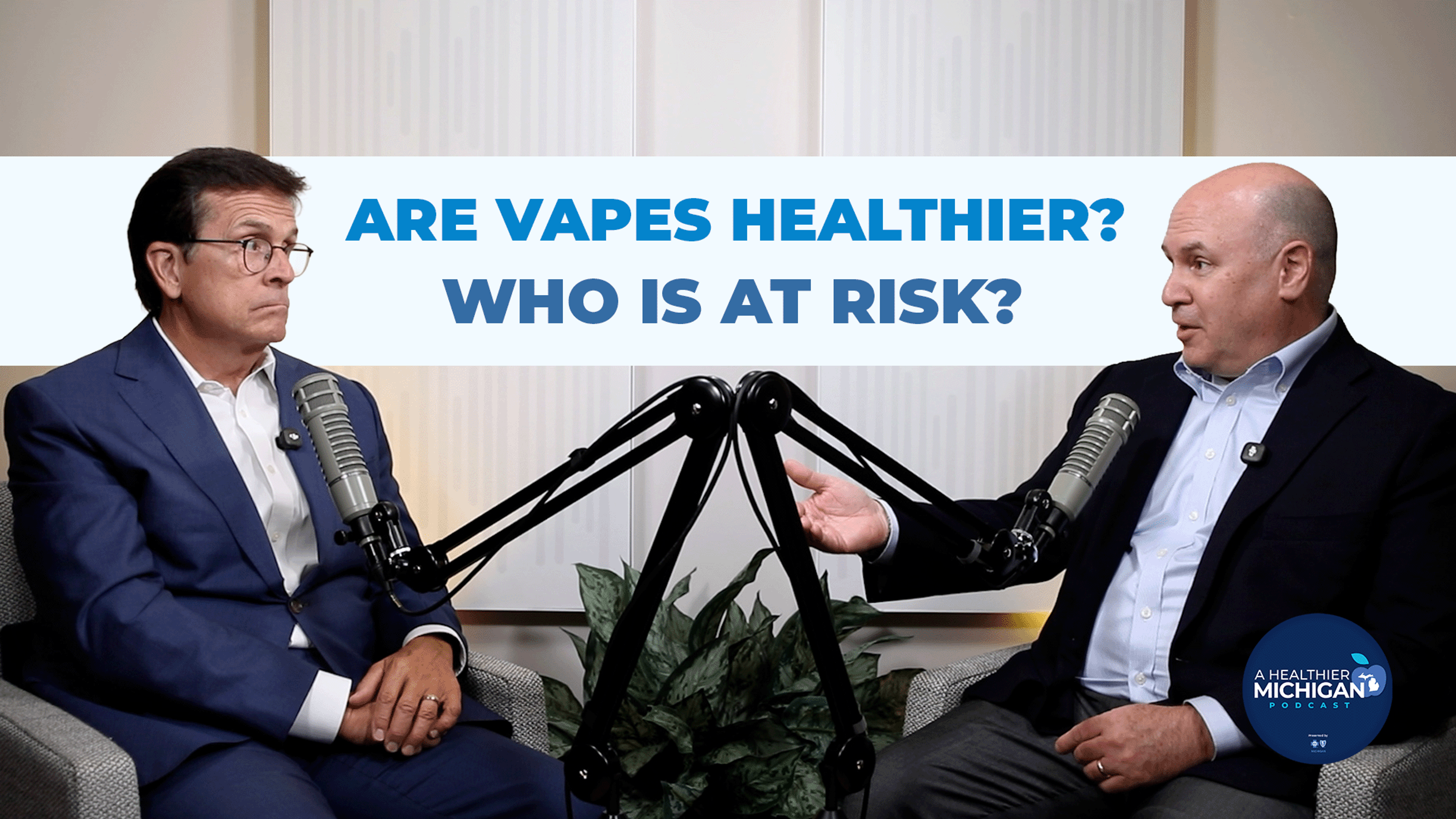
Vapes can look small, sleek and harmless, but what happens when the aerosol reaches your lungs, heart and brain? On this episode, host Chuck Gaidica is joined by Associate Chief Medical Officer Dr. Peter Graham to explain e-cigarettes, why they are pushed as “healthier” and why teens are so at risk of using them.
In this episode of A Healthier Michigan Podcast, we explore:
- What is a “vape?”
- What effects do they have on us?
- Why are they marketed to a younger audience?
- Are they healthier than cigarettes?
Transcript
Are Vapes Safer Than Other Tobacco Products?
Chuck Gaidica:
Vapes can look small and sleek, harmless. But what happens when the aerosol reaches your lungs, reaches your heart, even your brain? And for teens whose brains are still developing, are the risks even greater? Today, we're cutting through the confusion to answer two important questions. Is vaping unhealthy and why does it pose a specific risk to teens?
Vapes can look small and sleek, harmless. But what happens when the aerosol reaches your lungs, reaches your heart, even your brain? And for teens whose brains are still developing, are the risks even greater? Today, we're cutting through the confusion to answer two important questions. Is vaping unhealthy and why does it pose a specific risk to teens?
Welcome to A Healthier Michigan Podcast. I'm your host, Chuck Gaidica. And today, Associate Chief Medical Officer Dr. Peter Graham joins us to explain what vaping does to the body, why teens face these distinct risks, and whether vaping is truly a safe alternative to smoking. Good to have you back. Let's set the stage here. This idea of vaping.
What is vaping and what are you actually inhaling?
And what are people actually inhaling? Because, you know, I don't care what it is. You stand in front of a campfire. You wouldn't do that all day either. So you are inhaling stuff. What is that stuff?
Dr. Peter Graham:
Well put. And start with the principle that your lungs are designed to inhale two things, air and a little bit of moisture. So anything else is a problem. And vaping, you're absolutely right. What a vape device is in short is a battery with a heating element and takes some substance, heats it up to the point where it's aerosolized. It's in small particles and then you inhale it. It looks kind of like smoke, feels kind of like smoke, steam, some people say, but it's still small particles of things that you're bringing into your lungs with the idea that your lungs will absorb that and it gets into your bloodstream.
Well put. And start with the principle that your lungs are designed to inhale two things, air and a little bit of moisture. So anything else is a problem. And vaping, you're absolutely right. What a vape device is in short is a battery with a heating element and takes some substance, heats it up to the point where it's aerosolized. It's in small particles and then you inhale it. It looks kind of like smoke, feels kind of like smoke, steam, some people say, but it's still small particles of things that you're bringing into your lungs with the idea that your lungs will absorb that and it gets into your bloodstream.
Chuck Gaidica:
And the stuff that's coming in is chemicals.And what is the particulate part of it? Because you're not burning paper in there, right?
And the stuff that's coming in is chemicals.And what is the particulate part of it? Because you're not burning paper in there, right?
Dr. Peter Graham:
No. In some ways, it might be a tiny bit less harmful than paper. The most common substance that people are vaping is nicotine, which is the active ingredient in tobacco, which is why people smoke or use chewing tobacco. But there are a lot of other things in that aerosol.Correct, there's oftentimes flavoring. So some of those chemicals that are associated with flavoring make it taste fresh, minty or fruity or all sorts of different flavors. So it tastes a little better. Unfortunately, it also tends to be attractive to kids, but those chemicals are really not designed to go in your lungs. And some of those can be pretty serious lung irritants.
No. In some ways, it might be a tiny bit less harmful than paper. The most common substance that people are vaping is nicotine, which is the active ingredient in tobacco, which is why people smoke or use chewing tobacco. But there are a lot of other things in that aerosol.Correct, there's oftentimes flavoring. So some of those chemicals that are associated with flavoring make it taste fresh, minty or fruity or all sorts of different flavors. So it tastes a little better. Unfortunately, it also tends to be attractive to kids, but those chemicals are really not designed to go in your lungs. And some of those can be pretty serious lung irritants.
Dr. Peter Graham:
The casing, the plastics, the heavy metals that make up both the heating element and the cartridge itself melt and aerosolize. Soyou're inhaling a little bit of that too every time you take a drag off a vape.
The casing, the plastics, the heavy metals that make up both the heating element and the cartridge itself melt and aerosolize. Soyou're inhaling a little bit of that too every time you take a drag off a vape.
Chuck Gaidica:
Wow. I never thought of it that way, becausethere's some off-gassing from just the hard part of the product itself then.
Wow. I never thought of it that way, becausethere's some off-gassing from just the hard part of the product itself then.
Dr. Peter Graham:
Yes, exactly.
Yes, exactly.
How vaping affects the lungs, heart and blood vessels
Chuck Gaidica:
So this idea of how it'sactually affecting our health, it sounds as I think about this idea, this sounds like there are many off ramps as to where this could go in your body.
So this idea of how it'sactually affecting our health, it sounds as I think about this idea, this sounds like there are many off ramps as to where this could go in your body.
Dr. Peter Graham:
Yes. And not only does it immediately cause problems in your lungs because it's irritating and damages the tissues in your lungs and your airways, most of those small particles, or a good portion of the small particles, will cross over into the circulation. I think you hinted at this in the intro, and some of those are damaging to blood vessels. That's part of why smoking cigarettes is so dangerous. It's not just what it does to your lungs,it's what it does to your circulatory system.Yeah, when something's in your circulatory system, it'simpactingpretty much every other organ in your body, including your brain, which is one we really try to protect from things that shouldn't be there.
Yes. And not only does it immediately cause problems in your lungs because it's irritating and damages the tissues in your lungs and your airways, most of those small particles, or a good portion of the small particles, will cross over into the circulation. I think you hinted at this in the intro, and some of those are damaging to blood vessels. That's part of why smoking cigarettes is so dangerous. It's not just what it does to your lungs,it's what it does to your circulatory system.Yeah, when something's in your circulatory system, it'simpactingpretty much every other organ in your body, including your brain, which is one we really try to protect from things that shouldn't be there.
Why vaping can be both physically and psychologically addictive
Chuck Gaidica:
It seems like this is for young people. Well, and maybe beyond that, there's also the psychological factor. It's not just a nicotine thing, right? As I thought about this episode, I'm thinking, well, there's the I'm hooked on it because it's nicotine.
It seems like this is for young people. Well, and maybe beyond that, there's also the psychological factor. It's not just a nicotine thing, right? As I thought about this episode, I'm thinking, well, there's the I'm hooked on it because it's nicotine.
But there's also, I think, maybe more, especially for young people, that's what I'm thinking, there's this cool factor. I'm smoking, but I'm not smoking. I've got a cool device, you know, so I think there's part of this that's psychological, right?
Dr. Peter Graham:
Absolutely. Same is true of cigarettes, incidentally. And, you know, I'm old enough to remember that was the signal of rebellion, having a Marlboro in your hand. But now it's a vape pen. That's part of it. Some people also just like to have something to do with their hands, and particularly if they tend to be a nervous or fidgety person, a vape is something you can hold or put up to your face and it just gives you some outlet for some of that energy.So that, plus, you're right, nicotine is an incredibly addictive substance. But those three things together, that becomes a very compulsive habit.
Absolutely. Same is true of cigarettes, incidentally. And, you know, I'm old enough to remember that was the signal of rebellion, having a Marlboro in your hand. But now it's a vape pen. That's part of it. Some people also just like to have something to do with their hands, and particularly if they tend to be a nervous or fidgety person, a vape is something you can hold or put up to your face and it just gives you some outlet for some of that energy.So that, plus, you're right, nicotine is an incredibly addictive substance. But those three things together, that becomes a very compulsive habit.
Flavors, marketing and why teens are drawn to vapes
Chuck Gaidica:
And you know, I don't know how much different it is than,you don't hear about it too much or meet people that are smoking a pipe, a traditional tobacco pipe, right? And actually, as a guy who never did, I would smell it from a distance and think, oh, that's a pleasant smell.
And you know, I don't know how much different it is than,you don't hear about it too much or meet people that are smoking a pipe, a traditional tobacco pipe, right? And actually, as a guy who never did, I would smell it from a distance and think, oh, that's a pleasant smell.
I don't know if anybody's getting that from vaping, but it seems like there's also a part of this that, you know, that oral thing where you're doing something that others aren't doing. Maybe it is a cool factor, but when you're breathing and you're trying to breathe better, which we all should hope to be wanting to do, and you're also now not thinking about how is it affecting an addiction or my concentration or stress or lack thereof, there are, again, many other ways it could be affecting you.
Dr. Peter Graham:
Oh, absolutely. And like I said, some people do find the aroma of it and just the smell and the ambiance of it kind of attractive. I'm not one of them and I don't find the same thing with cigarettes, but some people do. They like those smells. And as I said with the flavored vapes, they're particularly attractive to adolescents, which is really a problem because that's who tends to pick it up and stick with it, like the fruity or minty or other kinds of smells and stick with it.
Oh, absolutely. And like I said, some people do find the aroma of it and just the smell and the ambiance of it kind of attractive. I'm not one of them and I don't find the same thing with cigarettes, but some people do. They like those smells. And as I said with the flavored vapes, they're particularly attractive to adolescents, which is really a problem because that's who tends to pick it up and stick with it, like the fruity or minty or other kinds of smells and stick with it.
Chuck Gaidica:
From a marketing standpoint, it's almost, I think, like going into a fast on-the-go store where they've got all these icy drinks with tropical flavor and the blue one and the pink one. And when I look at vaping, I'm thinking that's if you look at even some of the packaging, it's very colorful. It does highlight the minty freshness, whatever it is. And so they really are going after that idea, well, this is kind of fresh, it's okay.
From a marketing standpoint, it's almost, I think, like going into a fast on-the-go store where they've got all these icy drinks with tropical flavor and the blue one and the pink one. And when I look at vaping, I'm thinking that's if you look at even some of the packaging, it's very colorful. It does highlight the minty freshness, whatever it is. And so they really are going after that idea, well, this is kind of fresh, it's okay.
Dr. Peter Graham:
Yeah, and in some ways almost healthy, like it's an alternative to smoking, which it really isn't.You know, is it better than tobacco? Maybe. I wouldn't want to stake my own life and health on it, but particularly aimed at children. And it's helpful to look at who is actually selling a lot of these things. It is tobacco companies. What they're really selling is nicotine. They're just trying to put it in a more attractive packaging for younger people.
Yeah, and in some ways almost healthy, like it's an alternative to smoking, which it really isn't.You know, is it better than tobacco? Maybe. I wouldn't want to stake my own life and health on it, but particularly aimed at children. And it's helpful to look at who is actually selling a lot of these things. It is tobacco companies. What they're really selling is nicotine. They're just trying to put it in a more attractive packaging for younger people.
Are tobacco companies repackaging nicotine for a new generation?
Chuck Gaidica:
And that's interesting you say that because as the world, not all parts of the world, there are still places, I think Asia and the Eastern bloc where smoking is still a huge thing, but generally it's been contracting. So now these larger companies are trying to figure out other ways to bring you into the fold, I guess.
And that's interesting you say that because as the world, not all parts of the world, there are still places, I think Asia and the Eastern bloc where smoking is still a huge thing, but generally it's been contracting. So now these larger companies are trying to figure out other ways to bring you into the fold, I guess.
Dr. Peter Graham:
Yeah, that's absolutely right. What they're essentially selling is nicotine, so whatever gives you a delivery system to get people to buy nicotine is worthwhile.
Yeah, that's absolutely right. What they're essentially selling is nicotine, so whatever gives you a delivery system to get people to buy nicotine is worthwhile.
Long-term health risks of vaping: what we know and what we don't
Chuck Gaidica:
So have you seen data about, again, I don't even know how to think about this, what are the long term effects? In essence, you're doing it and it's probably the same for smoking. I've never been a smoker, but if you are doing it and it's not causing harm now, and a lot of young people and people in general live in the now, right? They're not thinking about 30 years out. Are you seeing anything that they should be thinking about now, or maybe even begin to feel after they've started this?
So have you seen data about, again, I don't even know how to think about this, what are the long term effects? In essence, you're doing it and it's probably the same for smoking. I've never been a smoker, but if you are doing it and it's not causing harm now, and a lot of young people and people in general live in the now, right? They're not thinking about 30 years out. Are you seeing anything that they should be thinking about now, or maybe even begin to feel after they've started this?
Dr. Peter Graham:
A little bit of both. There are kind of three parts that I would encourage people to look at. One is just the hazards of inhaling hot vapor. The other thing I neglected to mention, when you're inhaling things that come out of a vape pen, they're also very hot. And thermal energy in your lungs is not a great thing either. So, smoke, thermal energy, the other chemicals and compounds, all very risky.
A little bit of both. There are kind of three parts that I would encourage people to look at. One is just the hazards of inhaling hot vapor. The other thing I neglected to mention, when you're inhaling things that come out of a vape pen, they're also very hot. And thermal energy in your lungs is not a great thing either. So, smoke, thermal energy, the other chemicals and compounds, all very risky.
We have seen it hasn't been around long enough to have the kind of 20-30 year studies we have with smoking tobacco or using chewing tobacco. But we have some inference in some case studies of acute illnesses which come up with vaping. There have been some really horrific cases with relatively rare lung conditions that are pretty much attributable directly to excess vaping, the damage it does to the lungs.So, some evidence that it is harmful.
How nicotine may impact the developing teen brain
The other thing that's a big unknown, especially with adolescents and using nicotine, we're not really sure what nicotine does to the developing brain, which is really something to think about. And ethically, it's not one you really want to try to study.
So if you look at 14, 15 year olds starting to vape, the brain is still in development really until they're in their early to mid 20s. There are a lot of risks potentially associated there.
Is vaping really safer than smoking cigarettes?
Chuck Gaidica:
Yeah, and the idea that you won't even know leaves this wide schism of a time period where you don't know what you're doing, right? I mean, you'd think it's fine, pretty much.
Yeah, and the idea that you won't even know leaves this wide schism of a time period where you don't know what you're doing, right? I mean, you'd think it's fine, pretty much.
How do we influence, many people believe that this is safer than smoking. Is that a right way to even think about it? I'm pretty sure you're saying no.
Dr. Peter Graham:
I'll answer this one a little carefully, because some of the audience is probably at some point in their life or currently a tobacco user, and their physician is encouraging them to use nicotine replacement as a method for getting off of cigarettes, or a patch or whatever. Patches, gum, lozenges, a lot of different ways to get at that. I don't want to leave the impression that your doctor is doing something harmful, because that is a good evidence-based treatment for people who are already nicotine dependent. Nicotine replacement and then taper is evidence based and very successful to get people to quit.
I'll answer this one a little carefully, because some of the audience is probably at some point in their life or currently a tobacco user, and their physician is encouraging them to use nicotine replacement as a method for getting off of cigarettes, or a patch or whatever. Patches, gum, lozenges, a lot of different ways to get at that. I don't want to leave the impression that your doctor is doing something harmful, because that is a good evidence-based treatment for people who are already nicotine dependent. Nicotine replacement and then taper is evidence based and very successful to get people to quit.
That said, when you have people who have never used it before and are suddenly becoming users, I hate to use the term because it gets overused, but it's almost like a gateway drug.And vapes are not cheap, by the way. The device itself is relatively pricey and the cartridges can vary in cost. On a per unit basis, the cigarette is actually cheaper. So unfortunately, it tends to kind of act the other way. It gets people introduced to nicotine and then more likely to pick up smoking as they age.From what we've seen, again, it's a pretty short time frame. We haven't really seen it over decades yet, but some evidence that it gets people to start smoking who wouldn't have otherwise, which is worrisome. So as an alternative, I would not look at it that way, and certainly not as a safe alternative.
Are nicotine-free vapes a healthy alternative?
Chuck Gaidica:
You know, in the world, I'm seeing articles from time to time about the nonalcoholic bar or meet up after work, it's a nonalcoholic thing, right? So I've now seen some of these vapes are being marketed as non-nicotine vapes. But everything else you've talked about to me seems to be, you know, you don't walk up to a house fire and say I can't wait to breathe it, right?Exactly. Or campfire as a kid, as a Boy Scout, it's like, well, we're going to be away from this deal. So there's still a lot in there that has nothing to do with nicotine. Maybe it's not as habit forming.
You know, in the world, I'm seeing articles from time to time about the nonalcoholic bar or meet up after work, it's a nonalcoholic thing, right? So I've now seen some of these vapes are being marketed as non-nicotine vapes. But everything else you've talked about to me seems to be, you know, you don't walk up to a house fire and say I can't wait to breathe it, right?Exactly. Or campfire as a kid, as a Boy Scout, it's like, well, we're going to be away from this deal. So there's still a lot in there that has nothing to do with nicotine. Maybe it's not as habit forming.
Dr. Peter Graham:
Absolutely correct. And it's taking on a risk. It's a finite risk, but it's a risk nonetheless with a lot of unknowns and just doesn't, there's really no way to responsibly call that a safe activity from a medical point of view.
Absolutely correct. And it's taking on a risk. It's a finite risk, but it's a risk nonetheless with a lot of unknowns and just doesn't, there's really no way to responsibly call that a safe activity from a medical point of view.
Short-term dangers of vaping: burns, lung injuries and popcorn lung
Chuck Gaidica:
So you mentioned long term studies don't really exist in a great form yet. But what about short term effects that you're hearing about that really are hitting home with young people that are using these things?
So you mentioned long term studies don't really exist in a great form yet. But what about short term effects that you're hearing about that really are hitting home with young people that are using these things?
Dr. Peter Graham:
Yeah, two that I'd highlight. One that would be familiar to folks who are in the emergency department world, fires and burns. The heating element of a vape pen, it's a lithium ion battery, and they get very, very hot sometimes. Even used properly, they can basically create almost a small fire. And if you're in the process of inhaling that at the time, it can cause a lot of damage, not just the mouth and throat, but in the upper airway, which are really difficult to treat and particularly hazardous.
Yeah, two that I'd highlight. One that would be familiar to folks who are in the emergency department world, fires and burns. The heating element of a vape pen, it's a lithium ion battery, and they get very, very hot sometimes. Even used properly, they can basically create almost a small fire. And if you're in the process of inhaling that at the time, it can cause a lot of damage, not just the mouth and throat, but in the upper airway, which are really difficult to treat and particularly hazardous.
The other is basically a condition where some of the substances that go into the cartridge are very similar to popcorn lung, which people may have heard of from time to time with microwave popcorn. Inhaling some of those liquids gets into the inner space of the lungs, sets up intense inflammation and inflammatory response, which can be life threatening. It's a really serious disorder. It's not common, I'll be honest, but a really concerning one.
How parents can talk to teens about vaping
Chuck Gaidica:
And some of what you're saying, well, the fire will affect anybody, but some of this is contextual. You may not know or your kid may not know that they've got a condition they're more susceptible to, right? And then this hits.
And some of what you're saying, well, the fire will affect anybody, but some of this is contextual. You may not know or your kid may not know that they've got a condition they're more susceptible to, right? And then this hits.
Dr. Peter Graham:
Absolutely correct.
Absolutely correct.
Chuck Gaidica:
Yeah. So we as parents have a role in this as influencers, if nothing else. But this is a thing that requires not only oversight but some talking to your kids. And I'm sure some kids are doing this and the parents don't even know. So we're not, this isn't our first rodeo. We were kids too, right? So we know that that happens.
Yeah. So we as parents have a role in this as influencers, if nothing else. But this is a thing that requires not only oversight but some talking to your kids. And I'm sure some kids are doing this and the parents don't even know. So we're not, this isn't our first rodeo. We were kids too, right? So we know that that happens.
Dr. Peter Graham:
Been one and raised a couple. So yes, I've lived that and took care of a lot of them over the years as a practitioner. So yes, kids do a lot of things we don't know about. And I'm going to keep my doctor hat on a little bit, but also put my dad hat on because, you know, like you, I have kind of experience with raising kids.
Been one and raised a couple. So yes, I've lived that and took care of a lot of them over the years as a practitioner. So yes, kids do a lot of things we don't know about. And I'm going to keep my doctor hat on a little bit, but also put my dad hat on because, you know, like you, I have kind of experience with raising kids.
What children need most in that kind of situation, particularly adolescents, is authoritative, not authoritarian, if that makes sense. They need you to listen, and they need you to know a few things and be willing to help them find the right information, but not judge, not make them feel uncomfortable.
Kids are kids. They were probably like this 10,000 years ago and they'll probably be like this, God willing, 10,000 years from now. They press boundaries. That's how they learn, it's how they grow. And if your kid comes in and says, hey, I'm doing this, is it safe? Or if you find the equipment and you're kind of curious about it, ask. Begin to treat them like the adults that they're becoming and give them a chance to talk about it a little bit and try to understand it, and then just kind of present facts. Here's what we know. We're not sure it's safe. We know it's expensive. We know it can lead to tobacco use. And give them a chance to ask questions on their own. I think that's probably the best way to approach it.
Why parents who smoke have a tougher conversation
Chuck Gaidica:
Yeah, and I think, as you mentioned that, I'm thinking back to there could be a credibility issue if mom and dad are smokers. So, you know, we all go through this with all the tough discussions we've got to have with our own kids. And they say, but, you know, when you were a kid, you told us that one time when you did this thing and you're like, yeah, I did, but that was in the rearview mirror.
Yeah, and I think, as you mentioned that, I'm thinking back to there could be a credibility issue if mom and dad are smokers. So, you know, we all go through this with all the tough discussions we've got to have with our own kids. And they say, but, you know, when you were a kid, you told us that one time when you did this thing and you're like, yeah, I did, but that was in the rearview mirror.
But if you're still an active smoker, it seems like it sets the table for a harder conversation, like, well, I'm okay, you're not, you shouldn't do it, you know. So it gets complicated.
Dr. Peter Graham:
100%. And the most powerful predictor of whether a young person is going to start smoking is if their own parent smokes.
100%. And the most powerful predictor of whether a young person is going to start smoking is if their own parent smokes.
Chuck Gaidica:
Wow.
Wow.
Dr. Peter Graham:
And if they have a parent who smokes, their odds of becoming a smoker go up almost geometrically. So yes, you're absolutely right. Good time to talk about maybe how you can look at strategies to work on it both ways. We know that works in marriages, for example. Both partners agree to quit at the same time if they smoke, much more likely to succeed. So if you're having a problem with it, at the same time, it's time to come clean and say, hey, kiddo, let's work on this.
And if they have a parent who smokes, their odds of becoming a smoker go up almost geometrically. So yes, you're absolutely right. Good time to talk about maybe how you can look at strategies to work on it both ways. We know that works in marriages, for example. Both partners agree to quit at the same time if they smoke, much more likely to succeed. So if you're having a problem with it, at the same time, it's time to come clean and say, hey, kiddo, let's work on this.
Chuck Gaidica:
So maybe there'll be some reverse influencing.That'd be great. So final thoughts on this whole topic. Wrap it up for us.
So maybe there'll be some reverse influencing.That'd be great. So final thoughts on this whole topic. Wrap it up for us.
Vaping is not a risk-free alternative
Dr. Peter Graham:
Not a safe alternative. Really something we just have too many unknowns about. If you're worried about what's going on with it, worried about what's going on with your kid, honest open conversation is best. Your family doctor or pediatrician is a great source of data on this. Also, mibluedaily.com has some really good information on this. CDC has some fantastic information as well, and it's a great place for people to look. We couldn't possibly cover all that in a 15-minute talk, so lots to learn.
Not a safe alternative. Really something we just have too many unknowns about. If you're worried about what's going on with it, worried about what's going on with your kid, honest open conversation is best. Your family doctor or pediatrician is a great source of data on this. Also, mibluedaily.com has some really good information on this. CDC has some fantastic information as well, and it's a great place for people to look. We couldn't possibly cover all that in a 15-minute talk, so lots to learn.
Chuck Gaidica:
That's good to know because not only just this episode but even the CDC, you know, kids don't come with directions. So sometimes we need encouragement from outside sources.
That's good to know because not only just this episode but even the CDC, you know, kids don't come with directions. So sometimes we need encouragement from outside sources.
Dr. Peter Graham:
Absolutely.
Absolutely.
Chuck Gaidica:
It'll be beyond just searching, so it's good to know that's out there. Good to see you. Thanks, Dr. Graham. Thanks so much. Hey, we want to thank you for being here. You know, at least this is not a cigarette. We hear this, we just heard that couched a little bit. Well, that's not really true. Maybe it's easy to think that e-cigarettes and vapes are harmless, but we've heard so much here today. We hope we showed you how this can harm others, harm kids, harm others in your family. And just because something is packaged with bright colors or it's got sweet smells and aromas or a taste doesn't necessarily make it good for you, and it may put your health at risk and those who you love.
It'll be beyond just searching, so it's good to know that's out there. Good to see you. Thanks, Dr. Graham. Thanks so much. Hey, we want to thank you for being here. You know, at least this is not a cigarette. We hear this, we just heard that couched a little bit. Well, that's not really true. Maybe it's easy to think that e-cigarettes and vapes are harmless, but we've heard so much here today. We hope we showed you how this can harm others, harm kids, harm others in your family. And just because something is packaged with bright colors or it's got sweet smells and aromas or a taste doesn't necessarily make it good for you, and it may put your health at risk and those who you love.
We thank you for joining us on a Healthier Michigan podcast, brought to you by Blue Cross Blue Shield of Michigan. If you like this episode, other episodes that we've done or what we're going to do, you can check us out anytime. Go online at AHealthierMichigan.com/podcast. You can leave us a rating. You can share the podcast. You can leave a comment, that may be the way you influence somebody in the family. Share this with them and maybe they'll listen to it. And that's the thing. You can subscribe, you can favorite us wherever you listen. And you can also check us out on YouTube. We hope we gave you a tip or two today to stay healthy and keep those in your circle healthy as well.
Until next time, I'm Chuck. Be well.